














































Why Walking Might Be the Most Underrated Health Habit

Every May, National Walking Month encourages us to do something deceptively simple: walk more. It sounds almost too basic to matter — but that assumption is exactly the problem.
Walking is one of the most powerful, accessible tools we have for improving health, boosting mood, and even fixing sleep. No expensive equipment. No complicated routines. Just movement.
The Physical Benefits: More Than Just “Getting Steps In”
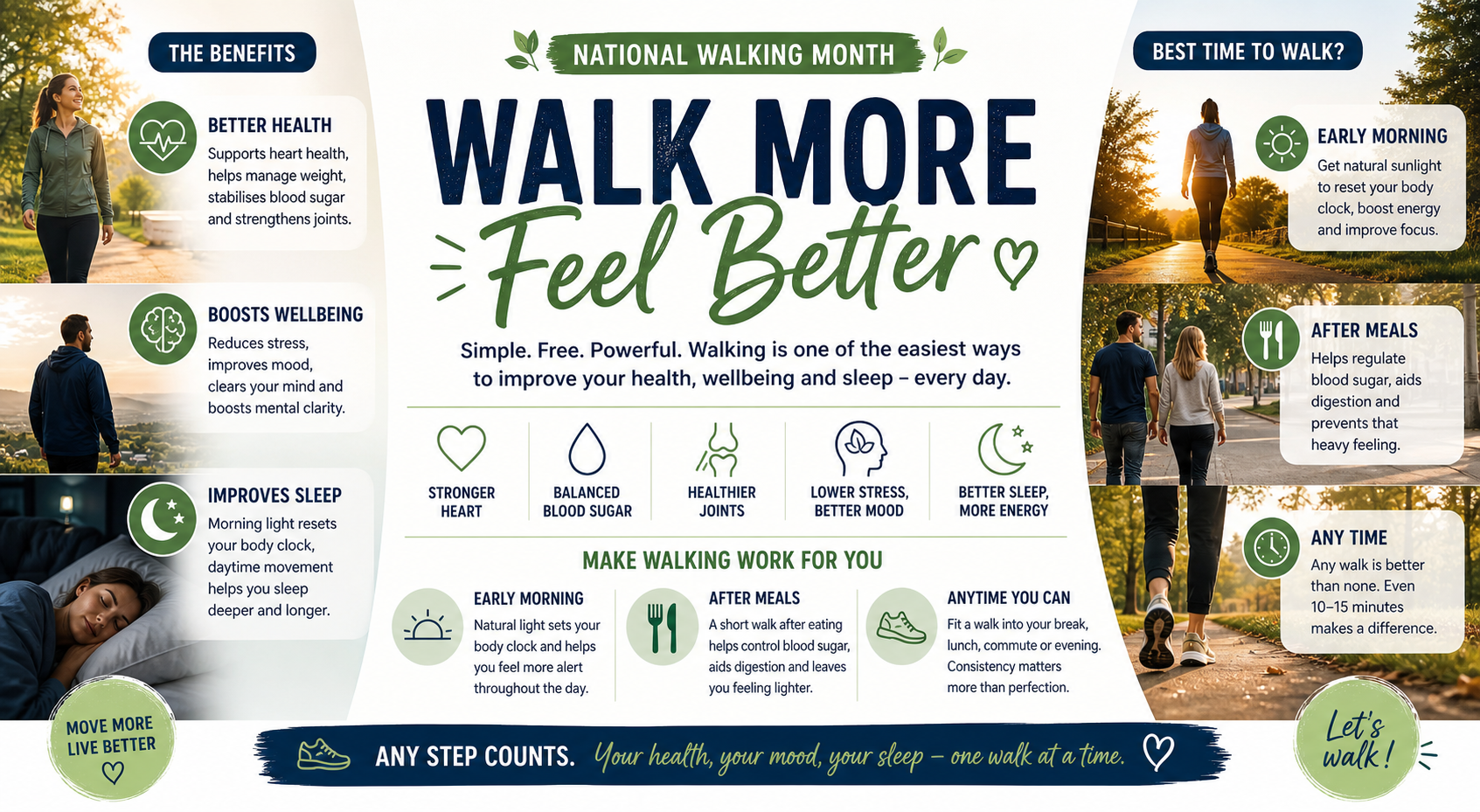
Walking regularly does far more than burn a few calories:
- Heart health improves – even moderate walking reduces the risk of cardiovascular disease
- Blood sugar stabilises – especially when walking after meals
- Joint health strengthens – movement lubricates joints and reduces stiffness
- Weight management becomes easier – not through intensity, but consistency
The key is frequency, not perfection. A 20–30 minute walk most days beats a single intense workout you can’t sustain.
Mental Wellbeing: The Quiet Reset Button
Walking has a unique psychological effect because it combines movement, rhythm, and environment.
- It reduces stress hormones like cortisol
- It creates space for clearer thinking and problem-solving
- It can act as a moving form of meditation
- Outdoor walking, especially in green spaces, boosts mood even further
If you’ve ever had your best ideas while walking, that’s not coincidence — it’s biology.
Sleep: The Overlooked Benefit
Sleep is where walking quietly does some of its best work.
- Morning walks help regulate your circadian rhythm through natural light exposure
- Daytime movement increases sleep pressure, making it easier to fall asleep
- Post-meal walks aid digestion, reducing discomfort that can disrupt sleep
If your sleep feels inconsistent, walking — especially earlier in the day — is one of the simplest interventions.
When Is the Best Time to Walk?
You’re right to question timing — but here’s the honest answer: the best time is the one you’ll actually stick to.
That said, different times offer different advantages:
Early Morning
- Exposure to natural light helps “set” your body clock
- Improves alertness and energy for the day
- Supports better sleep later that night
After Meals (Especially Dinner)
- Helps regulate blood sugar
- Aids digestion
- Can prevent that heavy, sluggish feeling
Anytime You Can Fit It In
- Consistency beats optimisation
- Even short walks (10–15 minutes) add up
- Breaking up long periods of sitting is hugely beneficial
If you’re waiting for the “perfect” time, you’ll walk less. If you walk whenever you can, you’ll get the benefits.
The Real Barrier Isn’t Time — It’s Friction
Most people don’t struggle with walking because it’s hard. They struggle because:
- It feels too small to matter
- It’s easy to postpone
- There’s no immediate payoff
That mindset is backwards. Walking works precisely because it’s easy to repeat.
A Simple Way to Start
Instead of setting big goals, try this:
- Walk for 10–15 minutes daily
- Add a short walk after one meal
- Get morning light at least a few times a week
Build the habit first. Increase later.
Final Thought
Walking won’t feel like a breakthrough habit — and that’s why it’s so powerful.
During National Walking Month, the goal isn’t to transform your life overnight. It’s to recognise that something ordinary, done consistently, can quietly improve your health, mood, and sleep in ways most “optimised” routines never will.
If you had to pick one habit to keep for the next decade, walking would be a surprisingly strong contender.
Leave a Comment